More accurate operations
Inspection data is captured as part of the workflow.
New: Chai, my AI assistant, can brief you on my work in 60 seconds.
Case study · PepsiCo · Field sales · Fleet
Bringing GeoTab telematics into PepsiCo’s SalesHub+ platform, so route sales reps can run vehicle inspections in a guided flow instead of by hand.
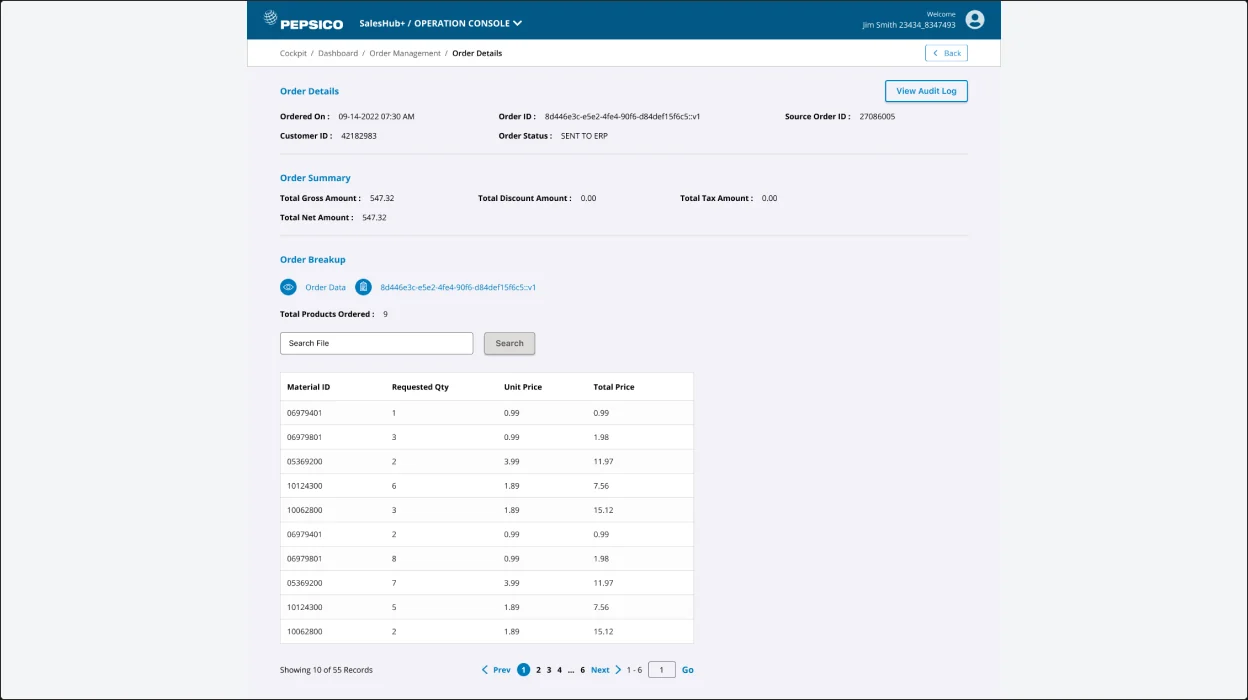
Order details in SalesHub+. Some data in the screens is blurred or replaced to respect PepsiCo confidentiality.
At a glance
The challenge
PepsiCo’s Route Sales Representatives (RSRs) did their daily vehicle inspections and defect reports by hand. Fleet data and inspection records sat outside SalesHub+, the platform they already used for sales.
What I led
The outcome
Daily vehicle checks moved from manual processes into one guided workflow.
Impact
Inspection data is captured as part of the workflow.
Defects are classified automatically.
Daily vehicle operations are easier to keep in line with regulations.
01 Context
SalesHub+ is the platform PepsiCo’s Route Sales Representatives (RSRs) use for their sales work. I worked on it for PepsiCo through Tech Mahindra. This project brought GeoTab telematics, and the daily vehicle inspection, into that same platform.
02 The problem
Before the integration, Route Sales Representatives (RSRs) completed daily vehicle inspections and reported defects by hand. Fleet data and inspection records were not part of SalesHub+, the platform RSRs already used for their sales work.
Make SalesHub+ the central place for fleet management and compliance, with accurate inspection data and fewer reporting errors.
Business goal
03 My role
As Senior UX/UI Designer and design lead for the GeoTab integration, I owned the UX/UI for the integration and for the guided inspection workflow that RSRs use. I did this work for PepsiCo through Tech Mahindra, as part of my role leading design on PepsiCo projects there.
04 Process
How RSRs completed daily inspections and reported defects by hand.
SalesHub+ as the central place for fleet management and compliance.
A guided flow, automatic defect classification and telematics data.
GeoTab data and a guided inspection inside SalesHub+.
05 Research
Looking at how inspections worked before the integration pointed to three gaps.
Daily vehicle inspections and defect reports were manual.
Fleet data and inspection records were not part of SalesHub+.
RSRs already used SalesHub+ for their sales work.
06 Users
07 Define
The inspection lives inside SalesHub+, next to the sales work RSRs already do there, and runs as one guided flow.
| RSR need | Design response |
|---|---|
| Complete the daily vehicle inspection | Guided inspection workflow |
| Capture vehicle data without re-entering it by hand | GeoTab telematics in SalesHub+, with real-time data capture |
| Report defects in a consistent way | Automatic defect classification |
08 Key decisions
The old process was manual. A step-by-step flow walks the RSR through each check in order.
Fewer reporting errors was a goal of the redesign. Automatic classification keeps defect reports in the same format.
Capturing vehicle data from GeoTab in real time reduces what the RSR has to type in.
09 Solution
Vehicle data from GeoTab now appears inside the platform RSRs already use.
RSRs follow a step-by-step inspection instead of a manual process.
Inspection data is recorded as the RSR goes, not entered afterwards.
Defects are sorted into categories automatically, so reports are consistent.
Design
Order details in SalesHub+: order summary with gross, discount, tax and net amounts, and an order breakup listing each material, quantity and price.
10 Validation
The workflow was judged against the goal set at the start: accurate inspection data, fewer reporting errors and SalesHub+ as the central place for fleet management and compliance.
RSRs completed daily vehicle inspections and reported defects by hand. Fleet data and inspection records sat outside SalesHub+.
RSRs follow a guided inspection inside SalesHub+. Vehicle data comes from GeoTab and defects are classified automatically.
11 Outcomes
SalesHub+ became the central place for fleet management and compliance.
RSRs complete vehicle inspections in a guided digital workflow instead of a manual process.
Operations became more accurate, reporting errors went down and regulatory compliance improved across daily vehicle operations.
12 Learnings
This project turned a manual process into a guided one, for people who do their work on the road, inside a tool they already used. The next step is to put the impact in numbers: inspection time, reporting errors and adoption by RSRs.